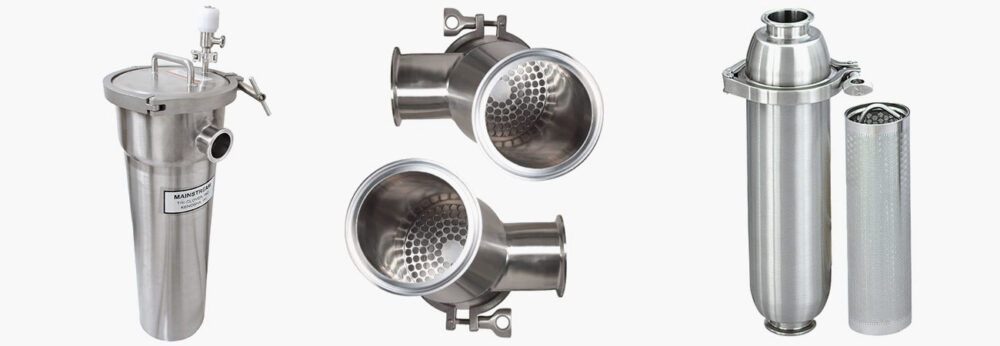
Unwanted particles can create serious problems in food, beverage, dairy, and other hygienic processing applications. They can clog fillers and dispensing equipment, damage downstream components, and affect the consistency, appearance, or flavor of the finished product.
Both filters and strainers help remove unwanted material, but they are designed for different jobs.
A simple way to understand the difference is to think about cooking. A strainer works like a colander that separates pasta from water, while a filter works more like a coffee filter that captures much smaller particles.
What Is the Difference Between Filtering and Straining?
Filtering is generally used for finer particle removal. Filter socks, cartridges, and other filter media can capture small particles ranging from fine sand-sized material down to extremely small contaminants, depending on the system and filter rating.
Straining is a coarser process. Strainers are typically used to catch larger pieces of debris before they reach pumps, valves, fillers, heat exchangers, and other sensitive equipment.
Before selecting either option, start with two basic questions:
- What needs to be removed from the product?
- How large are the unwanted particles?
The answers will help determine the proper screen opening, filter media, and system design.
Understanding Mesh and Micron Ratings
Mesh and micron are two common ways to describe particle size and screen openings.
A micron is one millionth of a meter. Smaller micron ratings indicate finer filtration.
Mesh refers to the number of openings per linear inch of screen. A higher mesh number generally means smaller openings. For example, a 35-mesh screen is approximately equivalent to a 500-micron opening, although exact conversions can vary based on wire thickness and screen construction.
Mesh ratings are commonly associated with strainers, while micron ratings are more frequently used when discussing filters.
When to Consider Wedge-Wire Screens
Wedge-wire, sometimes referred to as Vee-Wire®, is often used in demanding applications where strength, durability, and product support are important.
The rigid screen construction can handle thicker or more viscous products and may not require the same internal support structure as a filter sock. This can make wedge-wire screens a strong option for applications where conventional filter media could collapse, shift, or restrict flow.
Selecting the Right Method
The proper filter or strainer should be based on the process rather than simply choosing the finest available screen.
Important considerations include:
- The size and type of particles being removed
- Product viscosity
- Required flow rate and pressure
- Acceptable pressure drop
- Sanitary or cleanability requirements
- Equipment orientation and available installation space
- How frequently the element must be inspected or cleaned
- The potential impact of particles on product quality and equipment
Smaller openings can improve particle removal, but they also restrict flow and may require more frequent cleaning. The goal is to find the right balance between protection, product quality, and production efficiency.
Equipment configuration also matters. Some filter and strainer designs must be installed vertically, while inline designs may allow greater flexibility. Magnetic strainers can also provide additional protection by capturing metal particles before they contaminate the product or damage downstream equipment.
Protecting Your Product and Your Equipment
The correct filtration or straining system can help protect pumps, valves, heat exchangers, fillers, and other processing equipment while supporting more consistent finished-product quality.
At Stuart W. Johnson & Company, we have helped food, dairy, beverage, and industrial processors keep production moving for more than 75 years. As an Alfa Laval Master Distributor and Authorized Service Center, we can help evaluate your process, identify the right filtration or straining approach, and support equipment from Alfa Laval and other manufacturers.
The right solution is not always the finest screen. It is the system that removes the unwanted material without creating unnecessary restrictions, downtime, or maintenance.